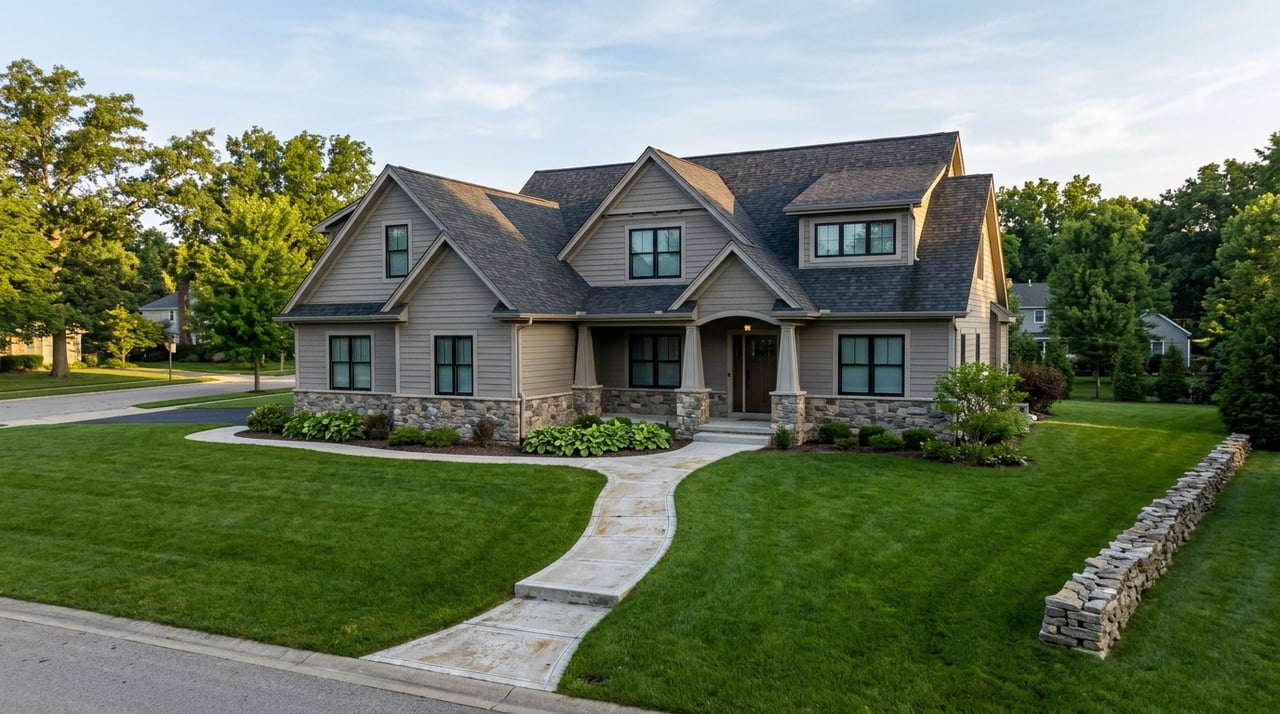
The Building Permit Rome Won't Give You Until You Get a Different Permit First
September 17, 2026
September 17, 2026
A buyer closes on a house in Between the Rivers, Rome's oldest neighborhood, planning to repaint the trim and swap out a rotted porch rail before move-in. An investor picks up a fixer two streets over in East Rome, budgets three weeks for cosmetic work, and lists it for rent by the end of the month. Both assume the same thing: paint is paint, and a rail is a rail, and the city cares about that stuff only when you're adding a room or tearing something down.
Neither assumption survives contact with Rome's actual ordinance. In one of the city's five local historic districts, painting the exterior of your own house is reviewed the same way a room addition is. The building permit office won't touch either project until a separate body, meeting once a month, signs off first. That single fact is the whole story behind more delayed rehabs, stalled listings, and confused closings in Rome's historic core than any inspection issue.
Georgia's model historic preservation law, the version most cities and most real estate guides describe, carves out an exception for the small stuff. Minor repairs and ordinary maintenance, like repainting a house or patching a roof with matching shingles, are treated as routine upkeep and left alone. That's the mental model a lot of buyers walk in with, especially if they've owned a historic-district property somewhere else in the state.
Rome's own ordinance doesn't carve out that exception. The city's Historic Preservation Commission page spells out exactly what gets swept into review before a building permit can issue:
reconstruction, renovation, restoration, maintenance, or painting of any
That's not boilerplate. Rome adopted its historic district zoning ordinance in 1979, a year before the state's model act existed, and an appellate ruling later confirmed the city is exempt from the state framework entirely. Rome wrote its own rules, and its own rules reach further than the version most people expect.
The gap between the assumption and the reality is the whole friction point, so here it is laid out side by side.
| What the general Georgia model assumes | What Rome's ordinance actually requires |
|---|---|
| Exterior paint changes are excluded from design review | Painting is explicitly listed as work requiring Commission review |
| Ordinary maintenance, like a same-material roof patch, doesn't need a hearing | Maintenance is named alongside renovation and restoration as reviewable work |
| Only structural changes trigger a permit hold | Driveways, retaining walls, and fences are also covered before a building permit issues |
Every item in the right column has to clear a Certificate of Appropriateness, the document the Commission issues once it decides a project fits the district, before the city's building inspection office will hand over a permit. Skip that order and the permit simply doesn't come.
Rome has five local historic districts, and every one of them runs through the same review body and the same monthly meeting. Between the Rivers is the largest by far, with 553 parcels stitched between the Etowah and Oostanaula rivers and the largest intact Victorian-era streetscape in the state. The other four are East Rome, Oakdene, Avenue A, and College Heights, each smaller but subject to the identical Certificate of Appropriateness process before any exterior work moves forward.
Buying in any of the five means the same calendar applies no matter which street you're on.
The Historic Preservation Commission meets the third Wednesday of every month at 2:30 p.m., in the Sam King Room at Rome City Hall, 601 Broad Street. Applications have to land ahead of a monthly cutoff. The city's own department pages don't fully agree on which day that cutoff falls, one lists the 25th of the month, another the 20th of the month prior, but the practical effect is identical either way: miss the window and the project waits a full month before it's even heard.
The paperwork itself has teeth most homeowners don't expect from a design review. Applications must be submitted in person and signed by the property owner directly, not just an agent or contractor. A yard sign announcing the pending case has to stay posted until the meeting happens. And every parcel under review has to be current on its property taxes before the Commission will even consider the request, a detail that matters more than it sounds for anyone buying a distressed or long-vacant historic property where back taxes are part of the deal.
If the Commission says no, the applicant can't simply revise and resubmit next month. A denied Certificate of Appropriateness can't come back before the board for roughly six months.
Rome doesn't treat this as a formality, and there's a court record to prove it. In M. Wayne Robinson Builder-Developer, Inc. v. City of Rome, a developer had already pulled valid demolition permits for three houses on what would become Avenue A. Before demolition started, the city held a hearing and designated that street a historic district. When the developer demolished the houses anyway, Rome sued, and the trial court issued a permanent injunction against further demolition without a Certificate of Appropriateness. The appellate court upheld it. Having a permit in hand didn't matter once the district designation caught up. Avenue A, one of the five districts on the map today, exists partly because the city was willing to litigate to protect it.
The process isn't designed to say no. A 2015 case from the Between the Rivers district shows what approval looks like in practice. At 407 E. Third Street, the Commission approved a substantial renovation for owner Stephen Googe, including new entryway columns to support an overhanging second story, replacement of rotted wood and worn cedar shakes on the front facade, and converting a small garage into an additional bedroom.
The same meeting handled a more complicated case at 225 Broad Street, a century-old building that started life as a movie theater. Architect Jessica Bittles argued that enlarged second-floor windows were structurally necessary given the beams behind the facade, calling the upper portion of the building the real asset worth preserving. The design came from Cevian Design Lab, whose principal, Mark Cochran, sits on the Commission and recused himself from voting on his own firm's plans. Owner Dr. J.C. Abdou's plan was to convert the second floor into a residence while finding a retail or commercial tenant for the ground floor. Both projects got approved. Neither got approved instantly.
For a buyer closing on a historic-district home, the fix is simple but easy to miss: don't assume cosmetic work is same-week work. If repainting or exterior repairs are part of the plan, that plan needs a Certificate of Appropriateness before it needs a contractor.
For an investor working a rehab timeline, the monthly meeting cadence has to be built into the schedule the same way a loan closing date or a contractor's availability would be. A project that assumes four weeks of exterior work can lose most of a quarter if the application misses one month's cutoff, especially if any part of the plan gets sent back for revision.
For a seller with a historic-district listing, knowing whether recent exterior work already carries an approved Certificate of Appropriateness is a real point of value, and knowing whether it doesn't is a real point of disclosure. Buyers researching this process are going to find the same ordinance language this article did.
This is exactly the kind of process where hands-on construction experience earns its keep. Jacob Calvert's development and rehab background at The Calvert Group means client renovation timelines get built around Rome's actual review calendar from day one, not discovered the hard way after a contractor is already on standby.
Does interior work need a Certificate of Appropriateness? No. The review authority covers exterior architectural features, meaning changes visible from the street. Interior renovations that don't alter the exterior appearance fall outside the Commission's scope.
Do fences and driveways really get the same review as a full renovation? Yes. Rome's ordinance names driveways, retaining walls, and fences alongside new construction and remodeling as work requiring review before a building permit issues.
What if I want to paint before I've even closed? Any exterior painting inside one of the five districts needs its own Certificate of Appropriateness regardless of when in the ownership timeline it happens. Planning that approval into the due diligence period, rather than the move-in week, avoids the surprise entirely.
If you're weighing a purchase, sale, or renovation inside one of Rome's five historic districts, The Calvert Group can walk through what the Commission's calendar means for your specific timeline before you're locked into one. Start with a free home valuation and a conversation about what your project actually requires.
Stay up to date on the latest real estate trends.
Connect with The Calvert Advantage for a real estate experience that goes beyond the ordinary. Whether you're interested in exclusive listings, exploring your home's value, or diving into our personalized services, let's connect to make your real estate aspirations a reality.