Calhoun's Median Home Price Is Two Different Markets Wearing One Number
September 10, 2026
September 10, 2026
Pull up two Calhoun listings that both cluster near the city's reported median and you can end up looking at a 1960s brick ranch two blocks off Wall Street with hardwood floors and a quarter-acre yard, and a brand-new build in a subdivision off I-75 with a builder warranty and a two-car garage. Both will show up under the same headline price. Neither is competing for the same buyer, and treating them as interchangeable is where a lot of Calhoun home searches go sideways.
That gap is the real story in Calhoun right now, more than the median itself.
Calhoun's median sale price has been sitting around $295,000 through most of 2026. Redfin's closed-sale tracking put the three-month median ending in May 2026 at $295,000, up just 0.2 percent from the same window a year earlier. Separate closing-level tracking through late August 2026 landed on the same $295,000 figure across 162 tracked sales over the trailing six months.
Where it gets interesting is what sits around that number. The middle half of those 162 closings, the range you'd expect the typical Calhoun buyer to land in, spanned from $250,000 to $336,440. That's an $86,440 spread in the middle of the market alone, before you even get to the cheaper or pricier quarter on either end.
For a city of roughly 19,500 people, that's a wide band. It's the kind of spread you see when a market isn't one continuous curve of similar homes at similar prices, but two distinct products getting averaged together into a single headline number.
Walk the blocks around Wall Street and you're in the older half of that spread. This is Calhoun's historic downtown core, the Calhoun Downtown Development Authority's business district, where Calhoun Coffee Company, Dubs BBQ, and Heavale Brewing Co. share storefronts with the Harris Arts Center and the GEM Theatre. The housing stock here is largely mid-20th-century ranch and traditional homes, often on larger lots, built well before anyone in Calhoun was talking about subdivisions.
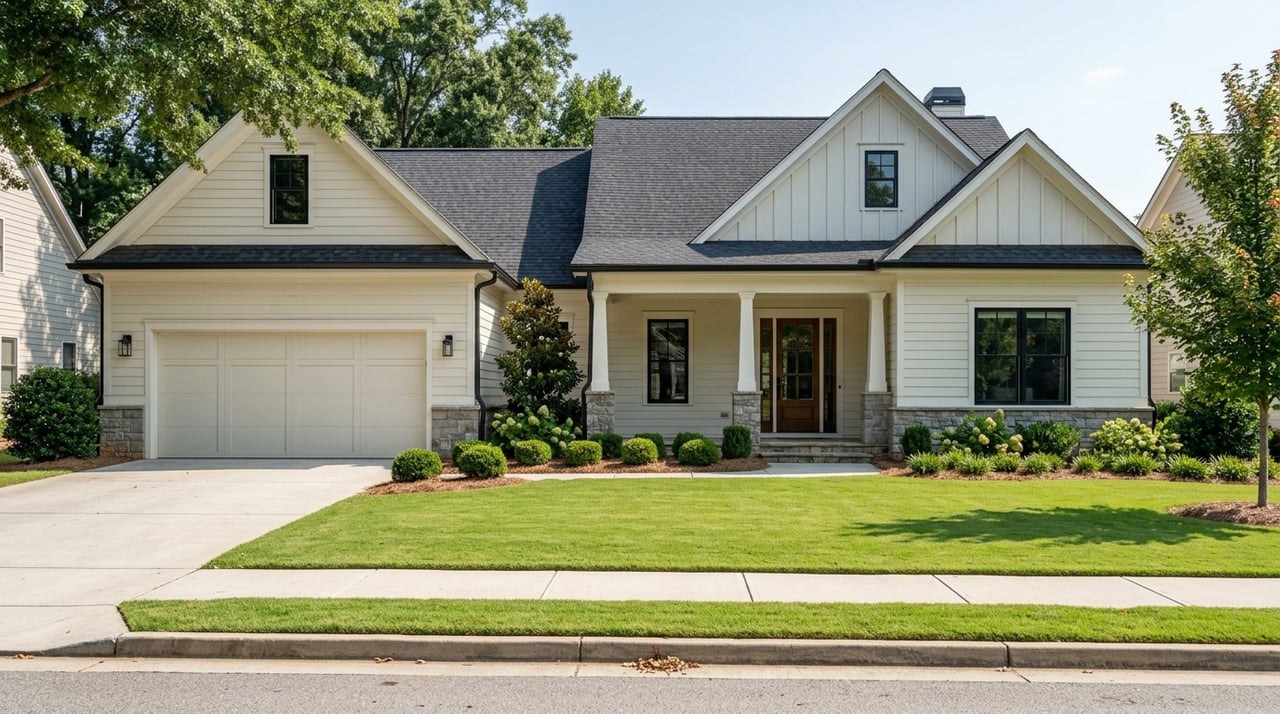
Drive toward the interstate and you're in the other half. National builders have been active in Calhoun for a while now. D.R. Horton has multiple communities in the area. Rocklyn Homes markets new construction directly to Calhoun buyers, describing itself as building neighborhoods designed for a sense of belonging near I-75 access. Smith Douglas Homes has also built here. Homes.com's own market description points to communities like Riverside at Calhoun, a new-construction neighborhood built around an established-neighborhood feel with a community pool minutes from the interstate.
These aren't just different price points. They're different products aimed at different buyers, built decades apart, sold through different channels, and often marketed with different language entirely, "charming and updated" for the older stock, "move-in ready with upgraded features" for the new builds.
| Old Calhoun (in-town core) | New Calhoun (subdivision growth) | |
|---|---|---|
| Typical location | Walkable blocks around Wall Street and downtown | New communities near I-75 |
| Typical age | Mid-20th century, some pre-war | Built within the last several years |
| Builders/developers | Individual owners, older construction | D.R. Horton, Rocklyn Homes, Smith Douglas Homes |
| Nearby amenities | Harris Arts Center, GEM Theatre, downtown restaurants | Community pools, HOA amenities, interstate access |
| Buyer profile | Long-tenure locals, downtown-lifestyle buyers | Relocating families, commuters, new-construction buyers |
A two-track market usually means one side is thriving while the other stalls. Calhoun's version doesn't quite play out that way, and the reason traces back to the city's economic base rather than anything happening in real estate itself.
Calhoun is regionally known as a manufacturing anchor, home to major operations for flooring giants Mohawk and Shaw. That kind of steady, locally rooted employment base does something a purely bedroom-community market doesn't get: it keeps a baseline of buyers shopping for the older, more affordable in-town stock year after year, regardless of what national builders are doing on the edge of town. Meanwhile the new-construction wave near the interstate is largely chasing a different, more mobile buyer, the kind moving in from Atlanta or Chattanooga for the highway access and the newer floor plan.
Both tracks can hold steady at the same time because they're not really drawing from the same pool of demand. That's part of why Calhoun's overall numbers look stable even while the spread inside them stays wide.
Here's where the data gets genuinely interesting for anyone timing a purchase. Closed-sale tracking from Redfin showed Calhoun homes selling faster in 2026 than the year before, with average time on market dropping to 68 days in the period ending May 2026, down from 73 days a year earlier, and the number of homes sold in May climbing to 70 from 63.
At the same time, list-side tracking from Movoto for June 2026 showed median price per square foot at $158, down 3 to 4 percent compared to the same month a year prior, even as median days on market held around 67 days.
Those two readings aren't contradicting each other so much as measuring different slices of the same split market. Closed-sale data captures what already sold, and if the older, more affordably priced in-town stock is turning over quickly, it can pull the overall days-on-market average down even while newer, pricier listings sit and negotiate on price per square foot before they close. A buyer looking only at the citywide days-on-market number could easily assume every Calhoun listing is moving briskly, when the more accurate read is that the two tracks are moving at different speeds for different reasons.
If you're shopping Calhoun with a portal search and a citywide median in hand, a few adjustments make that number actually useful:
Is Calhoun's housing market moving fast or slow right now? It depends which segment you're asking about. Closed-sale data through May 2026 showed shorter average time on market and more homes selling than a year earlier, but that pace reflects the in-town core more than the newer subdivision inventory, which list-side data suggests is negotiating more on price.
Why don't the days-on-market numbers and price trends match up? They're drawn from different stages of a sale. Closed-sale tracking reflects what already sold and tends to favor whichever segment is turning over fastest, while list-side price-per-square-foot tracking reflects everything currently on the market, including pricier new construction that may take longer to find its buyer.
Does the manufacturing base in Calhoun actually affect home prices? Not directly, but it affects demand stability. A steady employment anchor tied to Mohawk and Shaw supports consistent buyer interest in the city's older, more affordable housing stock, which helps explain why that segment keeps selling briskly even as a separate wave of new construction targets a different kind of buyer entirely.
Calhoun's median price is a fine starting point for a search. It's a poor stopping point. If you want a straight answer on which track a specific Calhoun listing actually belongs to, and what that means for your offer, Jacob Calvert and the Calvert Group can walk you through the comparables that actually apply to your situation. Start with a free home valuation and get numbers built for your specific search, not the citywide average.
Stay up to date on the latest real estate trends.
Connect with The Calvert Advantage for a real estate experience that goes beyond the ordinary. Whether you're interested in exclusive listings, exploring your home's value, or diving into our personalized services, let's connect to make your real estate aspirations a reality.